
EPOXY FLOORING SYSTEM FOR – ENGINEERING, FABRICATION WORKSHOPS & HEAVY MANUFACTURING PLANTS
Introduction
Engineering and fabrication workshops along with heavy manufacturing plants require flooring systems that can withstand heavy mechanical loads, frequent impact, and exposure to oils, lubricants, and industrial fluids. The floors must resist abrasion, vibration, and the movement of heavy trolleys or machinery while maintaining strength and surface integrity.
The Epoxy Flooring System for – Engineering, Fabrication Workshops & Heavy Manufacturing Plants is a high-build, heavy-duty epoxy flooring system designed for load-bearing strength, abrasion resistance, and long-term durability. Applied at a minimum thickness of 3000 microns, this system ensures consistent protection under the most demanding workshop environments.
Recommended Use Cases
- Engineering and fabrication workshops
- Heavy machine assembly areas
- Component repair and maintenance workshops
- Metal works and industrial manufacturing floors
- Toolmaking and machining zones
Step-Wise System Description
Step 1: Surface Preparation
Proper substrate evaluation and preparation are critical for long-term system performance.
- All necessary surface repairs, including crack filling or substrate restoration, must be completed prior to the application of any epoxy flooring materials. Ressichem offers a range of suitable crack fillers and repair compounds, including non-shrink cementitious grouts, specifically designed for surface preparation and repair.
- Concrete strength verification is essential before coating. The required compressive strength should be defined by the project consultant based on expected mechanical load.
- Conduct surface strength testing using destructive (core testing) where feasible and non-destructive methods, such as a Schmidt Hammer Test, to ensure substrate suitability.
- For major repairs (≥12 mm and above), use Ressi NSG 710, a high-strength, non-shrink cementitious grout capable of achieving high compressive strength suitable for industrial restoration.
- For minor surface repairs and voids, blend Ressi EPO Primer LV with Ressichem’s washed, graded, and completely dried silica sand (zero moisture content) to form a strong epoxy-sand mortar for patching and surface correction.
- Mechanically prepare the substrate through shot blasting or grinding, followed by vacuum cleaning to remove dust, oil, and laitance. This step is especially important if there is old oil, grease or any penetrative material previously present in the concrete. Old contaminants need to be completely cleared out prior to any Epoxy treatment over the cementitious floor surface.
Step 2: Application of Ressi EPO Primer LV
- Apply Ressi EPO Primer LV, a solvent-free, low-viscosity epoxy primer formulated to deeply penetrate and seal the substrate for optimal adhesion.
- Mix resin and hardener components accurately according to the datasheet.
- Apply evenly using a trowel or epoxy squeegee, ensuring complete surface coverage.
- Allow the primer to cure under controlled temperature and humidity conditions before proceeding.
Step 3: Application of Ressi EPO Mid Coat S – GP (Optional)
- Apply Ressi EPO Mid Coat S – GP, a compulsory high-build epoxy layer providing structural strength, levelling, and resilience under heavy traffic.
- Apply using a notched trowel or epoxy squeegee for a dense, uniform build.
- Recommended minimum thickness 1000 microns, with 2000 microns preferred for enhanced performance and surface smoothness.
- Allow full curing before the next application stage.
Step 4: Application of Final Epoxy Topcoat
- Apply Ressi EPO Floor Plus or Ressi EPO Floor Plus Econo, depending on the project’s aesthetic and cost considerations.
- Ressi EPO Floor Plus: Offers customizable color options for a polished appearance.
- Ressi EPO Floor Plus Econo: Economical version available in standard grey with identical performance properties.
- Apply using a high-build epoxy squeegee or trowel to a minimum thickness of 2000 microns.
- Allow 48–72 hours before permitting light use and 7 days for full mechanical and chemical curing.
Step 5: Floor Markings (If Required)
- For workflow zoning, safety markings, or equipment pathways, apply Ressi EPO Gloss Might in contrasting colors.
- Apply with a roller after the main epoxy system has fully cured.
- For cost-effective options, Ressi EPO Roll Coat may be used for lane or boundary markings.
Note:
- The total system thickness must be a minimum of 3000 microns to meet heavy-duty performance requirements.
- Always refer to the Technical Datasheets (TDS) for detailed mixing, curing, and application parameters before installation.
System Advantages
- High Mechanical Strength: Withstands vibration, equipment load, and impact stress.
- Chemical Resistance: Performs effectively against oils, lubricants, and cleaning agents.
- Repair Compatible: Accepts both epoxy and cementitious repair systems without adhesion loss.
- Customizable Appearance: Available in standard or color-customized finishes.
- Seamless and Dense Build: Non-porous system prevents dusting and facilitates easy cleaning.
- Long-Term Performance: Engineered for durability under heavy industrial conditions.
Maintenance Guidelines
- Clean floors with mild, neutral detergents; avoid harsh solvents or acidic agents.
- Inspect regularly for impact damage or wear in high-traffic zones.
- Recoat or refurbish as required to maintain film thickness and aesthetics.
- Prevent prolonged chemical pooling and ensure proper drainage.
System Summary Table
| Parameter | Description |
|---|---|
| System Name | Epoxy Flooring System for – Engineering & Fabrication Workshops |
| Area Type | Heavy-Duty Industrial, Engineering & Fabrication Environments |
| Traffic Exposure | Heavy Equipment, Forklifts, Machinery, and Impact Loads |
| Primary Requirements | Strength, Abrasion Resistance, Oil & Chemical Resistance |
| Primer | Ressi EPO Primer LV |
| Mid Coat (Optional) | Ressi EPO Mid Coat S – GP (1000–2000 microns) |
| Topcoat | Ressi EPO Floor Plus / Ressi EPO Floor Plus Econo (2000 microns) |
| Marking Coat (Optional) | Ressi EPO Gloss Might / Ressi EPO Roll Coat (Contrasting Colors) |
| Silica Used | Washed, graded, and completely dried (zero moisture content) silica sand |
| Total System Thickness | Minimum 3000 Microns |
| Application Method | High-Build Trowel or Epoxy Squeegee (Roller Only for Markings) |
| Finish Type | Smooth, Semi-Gloss |
| Curing Time Before Use | 48–72 Hours for Light Use / 7 Days for Full Cure |
| Key Benefits | Heavy Load Endurance, Chemical Resistance, Easy Maintenance, Long Service Life |
Conclusion
The Epoxy Flooring System for – Engineering, Fabrication Workshops provides a robust, high-strength, and chemically resistant flooring solution for demanding industrial environments.
The sequence — Surface Preparation, Ressi EPO Primer LV, Ressi EPO Mid Coat S – GP, Ressi EPO Floor Plus or Floor Plus Econo, (Optional) Ressi EPO Gloss Might or Roll Coat — ensures superior mechanical strength, load endurance, and long-term protection against industrial stresses.
System Summary
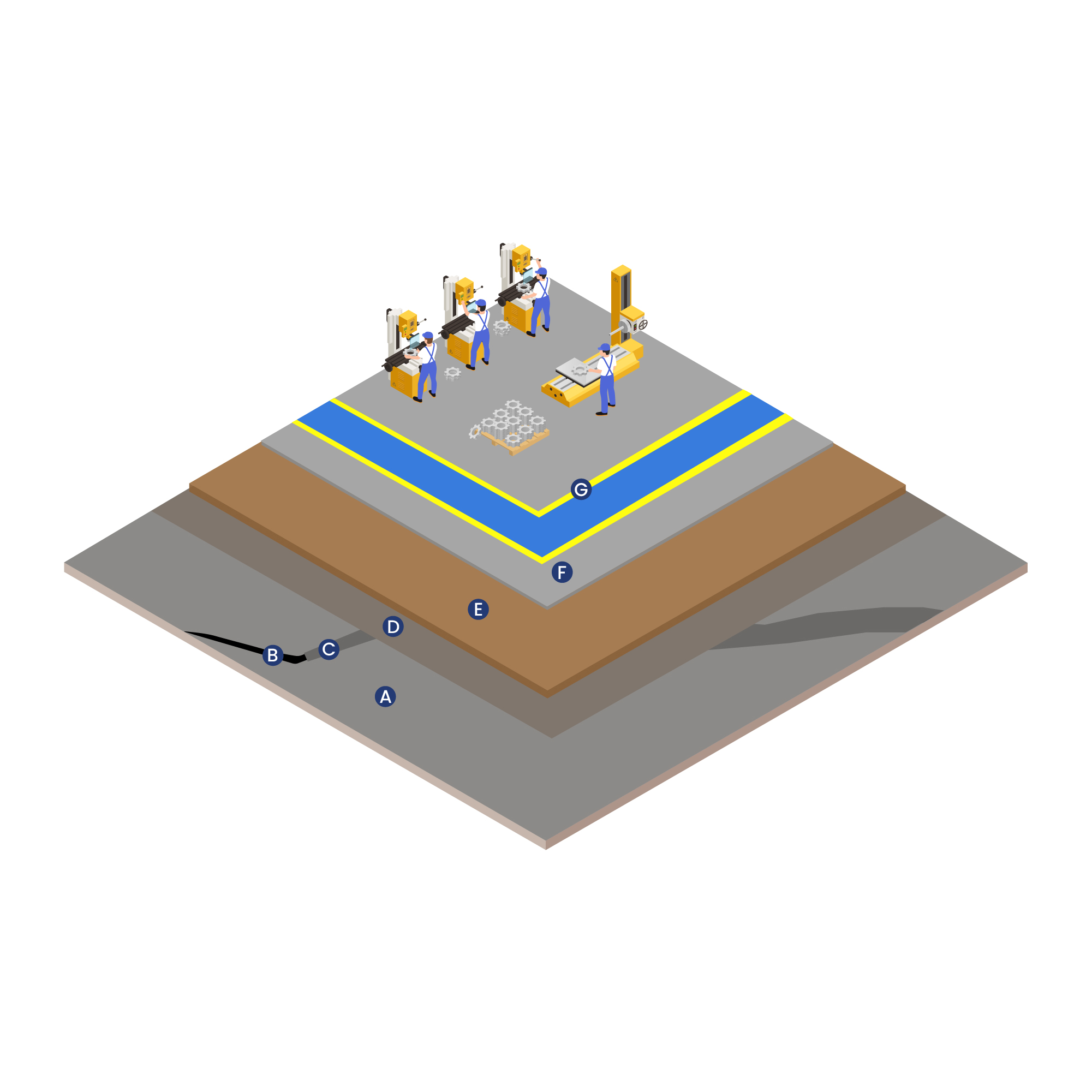
A Cementitious Surface: (Concrete slab or screed)
B Cracks and surface damage
C Crack Filler and Repairing Materials
D Ressi EPO Primer LV
E Ressi EPO Mid Coat S – GP
F Ressi EPO Floor Plus / Ressi EPO Floor Plus Econo
G Ressi EPO Gloss Might / Ressi EPO Roll Coat (Marking)