
EPOXY FLOORING SYSTEM FOR – CHEMICAL PROCESSING & REFINERIES
Introduction
Chemical processing facilities and refineries demand flooring systems with exceptional chemical resistance, thermal stability, and mechanical durability. These areas often face exposure to acids, alkalis, solvents, fuels, and corrosive agents, combined with the stress of heavy equipment movement.
The Epoxy Flooring System for – Chemical Processing & Refineries is a high-build, heavy-duty system engineered for long-term performance in chemically aggressive and high-traffic industrial environments. It ensures maximum resistance to chemical attack, abrasion, and impact, providing a seamless and protective surface for critical plant operations.
Recommended Use Cases
- Chemical manufacturing and blending zones
- Refineries and petrochemical plants
- Tank farms and mixing stations
- Laboratories and testing areas within industrial plants
- Pump rooms and containment areas
Step-Wise System Description
Step 1: Surface Preparation
Accurate substrate evaluation and preparation are vital for achieving optimal adhesion and chemical resistance.
- All necessary surface repairs, including crack filling or substrate restoration, must be completed prior to the application of any epoxy flooring materials. Ressichem offers a range of suitable crack fillers and repair compounds, including non-shrink cementitious grouts, specifically designed for surface preparation and repair.
- Concrete strength verification must be confirmed by the project consultant, in line with expected mechanical and operational loads.
- Perform testing using destructive (core samples) and non-destructive (Schmidt Hammer) methods to evaluate substrate integrity.
- For major repairs (≥12 mm), apply Ressi NSG 710, a high-strength, non-shrink cementitious grout.
- For minor repairs and surface voids, blend Ressi EPO Primer LV with Ressichem’s washed, graded, and completely dried (zero-moisture) silica sand to prepare an epoxy-sand repair mortar.
- Mechanically prepare the surface using shot blasting or diamond grinding.
- Ensure the substrate is clean, dust-free, and completely free from oil or grease contamination.
- This step is especially important for older floors where oil staining or grease penetration has occurred; thorough degreasing and cleaning must be performed before coating.
Step 2: Application of Ressi EPO Primer LV
- Apply Ressi EPO Primer LV, a low-viscosity, solvent-free epoxy primer providing deep substrate penetration and superior bonding.
- Mix resin and hardener as per datasheet instructions.
- Apply using a trowel or epoxy squeegee to ensure complete coverage.
- Allow full curing before proceeding.
Step 3: Application of Ressi EPO Mid Coat S – CR
- Apply Ressi EPO Mid Coat S – CR, a chemical-resistant, high-build epoxy layer that reinforces the substrate and forms the structural body of the flooring system.
- Apply using a notched trowel or epoxy squeegee for uniform build.
- Recommended minimum thickness 1000 microns, with 2000 microns preferred for enhanced resistance to impact and chemical exposure.
- Allow curing before applying the topcoat.
Step 4: Application of Final Epoxy Topcoat – Ressi EPO Chem Plus
- Apply Ressi EPO Chem Plus, a mandatory, high-performance chemical-resistant topcoat designed to withstand strong acids, alkalis, solvents, and fuel spills typical in chemical and refinery operations.
- Apply using a trowel or epoxy squeegee at a minimum thickness of 1000 microns.
- Spread evenly to achieve a seamless and chemically stable finish.
- Allow 48–72 hours for light use and 7 days for complete cure.
Step 5: Floor Markings (If Required)
- If demarcation lines or safety markings are needed, apply Ressi EPO Chem Might in contrasting colors.
- Apply with a roller only after the main flooring system has fully cured.
- Ideal for safety walkways, containment boundaries, or equipment zones.
Note:
- The total system thickness must be a minimum of 3000 microns for heavy-duty protection.
- Always refer to Ressichem Technical Datasheets (TDS) for detailed product information and curing parameters.
System Advantages
- High Chemical Resistance: Performs effectively against acids, alkalis, fuels, and solvents.
- Mechanical Durability: Withstands heavy vehicular and equipment movement.
- Seamless Protection: Non-porous finish resists penetration and contamination.
- Thermal Stability: Tolerates moderate thermal cycling typical in process environments.
- Repair Compatible: Integrates with epoxy and cementitious patch systems.
- Long Service Life: Designed for extreme industrial duty cycles.
Maintenance Guidelines
- Clean routinely using neutral pH or mild industrial detergents.
- Remove spills of corrosive chemicals immediately.
- Inspect high-load or chemical-exposed areas periodically for wear.
- Periodic maintenance should include re-coating of the flooring system whenever required to maintain chemical resistance and film thickness.
- Keep drainage channels clear and avoid prolonged standing liquids.
System Summary Table
| Parameter | Description |
|---|---|
| System Name | Epoxy Flooring System for – Chemical Processing & Refineries |
| Area Type | Heavy-Duty Chemical & Refinery Operations |
| Traffic Exposure | Heavy Equipment, Forklifts, Chemical Spillage |
| Primary Requirements | Chemical Resistance, Mechanical Strength, Thermal Stability |
| Primer | Ressi EPO Primer LV |
| Mid Coat (Compulsory) | Ressi EPO Mid Coat S – CR (1000 – 2000 microns) |
| Topcoat (Mandatory) | Ressi EPO Chem Plus (1000 microns) |
| Marking Coat (Optional) | Ressi EPO Chem Might (Contrasting Colors) |
| Silica Used | Washed, graded, and completely dried (zero moisture content) silica sand |
| Total System Thickness | Minimum 3000 Microns |
| Application Method | High-Build Trowel or Epoxy Squeegee (Roller Only for Markings) |
| Finish Type | Smooth, Semi-Gloss, Chemical-Resistant |
| Curing Time Before Use | 48–72 Hours (Light Use) / 7 Days (Full Cure) |
| Key Benefits | Corrosion Resistance, Long Service Life, Heavy Load Tolerance, Easy Maintenance |
Conclusion
The Epoxy Flooring System for – Chemical Processing & Refineries provides unmatched protection, chemical resistance, and mechanical endurance for aggressive industrial environments.
The sequence — Surface Preparation, Ressi EPO Primer LV, Ressi EPO Mid Coat S – CR, Ressi EPO Chem Plus, Ressi EPO Chem Might (Marking) — ensures a seamless, corrosion-resistant, and long-lasting flooring solution suitable for continuous operation in refinery and chemical-plant conditions.
System Summary
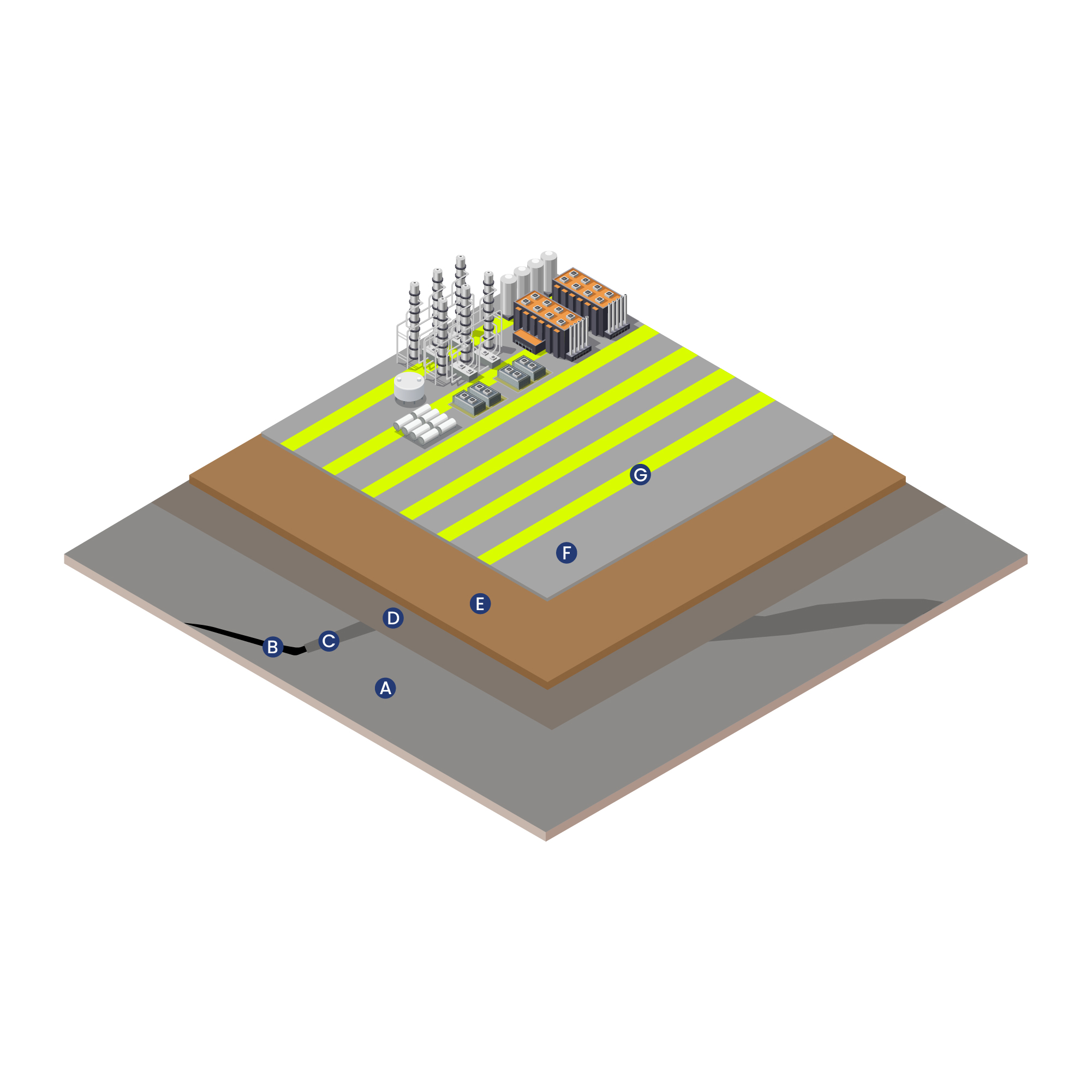
A Cementitious Surface: (Concrete slab or screed)
B Cracks and surface damage
C Crack Filler and Repairing Materials
D Ressi EPO Primer LV
E Ressi EPO Mid Coat S – CR
F Ressi EPO Chem Plus
G Ressi EPO Chem Might (Marking)