
EPOXY FLOORING SYSTEM FOR CAFETERIAS, CANTEENS, AND DRY STORAGE AREAS
Introduction
Cafeterias, canteens, and dry storage areas typically experience moderate foot traffic, regular cleaning, and exposure to mild moisture and food-related spills. The flooring system in these environments must prioritize functionality, hygiene, and long-term value over decorative appearance.
This epoxy flooring system from Ressichem provides a cost-effective yet durable flooring solution designed to withstand daily operational demands. By combining reliable primers, optional levelling layers, and a robust epoxy topcoat, the system ensures a seamless, hygienic, and easy-to-maintain surface — ideal for areas where practicality and longevity are key considerations.
Recommended Use Cases
- Cafeterias and institutional dining spaces
- Corporate and school canteens
- Food preparation corridors and serving areas
- Dry goods and packaging storage zones
Step-Wise System Description
Step 1: Surface Preparation
- The quality of surface preparation directly affects system adhesion and longevity.
- Begin with a reasonably levelled screed of good strength free from laitance, dust, oil, grease, and contaminants.
- Mechanically grind or lightly shot blast the surface to create a clean, open texture.
- Fill cracks and surface imperfections with an epoxy-based repair material. All Floor damages should be repaired with suitable Repairing materials. Ressichem has a wide range of concrete repairing materials.
- Ensure that the substrate’s moisture content is below 5% before proceeding.
Step 2: Application of Ressi SLS Primer – 1 (if Required)
- Where enhanced bonding is needed before applying a self-levelling layer, use Ressi SLS Primer – 1, a latex-based primer formulated to improve adhesion.
- Stir thoroughly before use.
- Apply uniformly by roller, brush, or spray.
- Avoid puddling or excess material.
- Allow to dry to a tack-free finish (typically 2–4 hours). In some cases the primer can be allowed to dry over night and subsequent self levelling screed can be applied later as well.
- This step improves bonding between the substrate and the optional self-levelling screed.
Step 3: Application of Ressi SLS 610 Self-Levelling Screed (if Required)
- If the substrate requires correction or levelling, apply Ressi SLS 610, a self-levelling cementitious screed.
- Mix with clean water per manufacturer’s recommendations using a low-speed mixer.
- Pour and spread evenly using a gauge rake or trowel.
- Use a spiked roller to release entrapped air and achieve a smooth finish.
- Ressi SLS 610 does not require curing, but it must be allowed 7–14 days for moisture release depending on ambient conditions.
- Proceed with epoxy application only once the moisture content is verified below 5%.
Step 4: Application of Ressi EPO Primer LV
- Once the surface is fully dry and stabilized, apply Ressi EPO Primer LV, a low-viscosity, solvent-free epoxy primer that penetrates and seals the substrate for improved adhesion.
- Mix resin and hardener thoroughly according to the specified ratio.
- Apply uniformly using a roller or brush.
- Avoid puddles and ensure complete coverage.
- Allow the primer to cure overnight before applying the epoxy topcoat.
Step 5: Application of Ressi EPO Tough Might Econo
- The final layer is Ressi EPO Tough Might Econo, a high-build, solvent-free epoxy coating designed to provide strong protection in economical applications where performance and value for money are the priority.
- Mix both components thoroughly using a low-speed mechanical mixer.
- It is recommended to apply the product in a single layer of 1000 microns. If need be two coat application techniques can also be used. Applications in lesser thicknesses may result in an orange peel epoxy texture finish.
- Light traffic can be opened within 48 to 72 hours of application. Full traffic and load to be opened over the surface in 7 Days after proper application.
- The finished surface offers excellent mechanical durability, abrasion resistance, and ease of maintenance, making it ideal for service-oriented and dry food areas.
System Advantages
- Economical and Efficient: Designed for cost-effectiveness without compromising durability.
- Durability: Withstands moderate mechanical impact and cleaning operations.
- Hygienic Surface: Seamless, non-porous finish prevents bacterial growth and dirt accumulation.
- Chemical Resistance: Protects against mild cleaning agents and food-related spills.
- Low Maintenance: Easy to clean with minimal upkeep.
- Value for Money: Provides a practical flooring solution prioritizing function over appearance.
Maintenance Guidelines
- Clean routinely using mild, non-abrasive detergents and soft cleaning pads.
- Avoid harsh solvents or highly acidic cleaners.
- Place floor mats at entrances to reduce grit and dirt.
- Inspect periodically for mechanical wear or surface dullness; recoat as necessary.
Note: Please refer to the product technical data sheets to have a detailed review of application techniques of the products.
System Parameters
| Parameter | Description |
|---|---|
| System Name | Food Service & Dry Storage Epoxy Flooring |
| Area Type | Cafeterias, Canteens, Dry Storage Areas |
| Traffic Exposure | Light to Medium Duty |
| Primary Requirements | Hygienic, Functional, Economical |
| Optional Layers | Ressi SLS Primer – 1, Ressi SLS 610 (Upon requirement) |
| Primer | Ressi EPO Primer LV |
| Topcoat | Ressi EPO Tough Might Econo |
| Total System Thickness | Minimum 1000 Microns |
| Finish Type | Smooth, Semi-Gloss (Functional) |
| Curing Time Before Use | 7 Days |
| Key Benefits | Economical, Hygienic, Durable, Value for Money |
Conclusion
For cafeterias, canteens, and dry storage areas, the Ressi EPO Tough Might Econo system delivers an ideal balance between performance, practicality, and economy. By following the structured process — Surface Preparation Ressi SLS Primer – 1 (if required), Ressi SLS 610 (if required), Ressi EPO Primer LV, Ressi EPO Tough Might Econo — the result is a seamless, durable, and value-driven flooring system designed to perform reliably in medium-duty, hygiene-critical environments.
System Summary
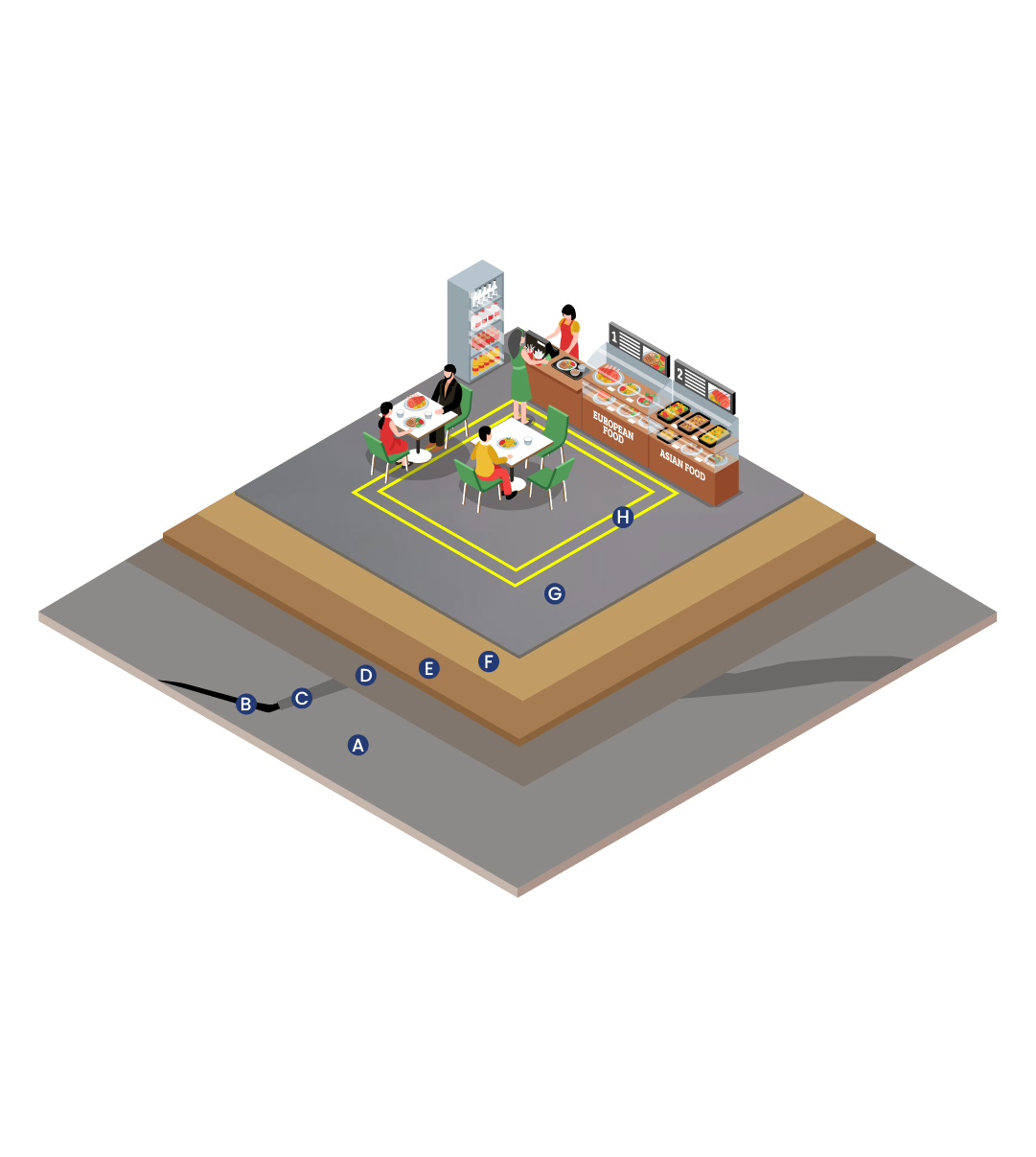
A Cementitious Surface: (Concrete slab or screed)
B Cracks and surface damage
C Crack Filler and Repairing Materials
D Ressi SLS Primer - 1 (Optional)
E Ressi SLS 610 (Optional)
F Ressi EPO Primer LV
G Ressi EPO Tough Might Econo
H Ressi EPO Tough Might (Marking) - Optional